What "zero dead pixel" actually covers?
A dead pixel is a pixel that fails to illuminate on command. On a power-on test, it shows as a dark spot on a white display or a bright spot on a black display. It's easy to detect, easy to count, and easy to set a pass/fail threshold on. This is why it became the standard quality promise - it's the most measurable thing about a screen, and therefore the easiest thing to guarantee.
The problem is that dead pixels represent only one of roughly a dozen ways an LCD or OLED panel can fail visually, and it's not even close to the most common one in real-world repair contexts. In our own warranty return data from the past 18 months, dead pixels accounted for 11% of returns. The other 89% were things the zero dead pixel promise doesn't cover at all.
Here's what the rest of the return data looked like:
- Backlight uniformity failures (visible hotspots or dimmer corners): 28%
- Touch calibration offset greater than 3mm: 19%
- Ghost touch or intermittent touch loss: 17%
- Backlight bleed at edges (appearing 4–10 weeks post-installation): 14%
- Colour temperature inconsistency within a batch: 6%
- Flex cable failure under normal installation handling: 5%
None of these are dead pixel issues. All of them result in a returned phone, a frustrated customer, and a conversation between the repair shop and their supplier that usually goes nowhere productive because the supplier's guarantee didn't cover any of them.
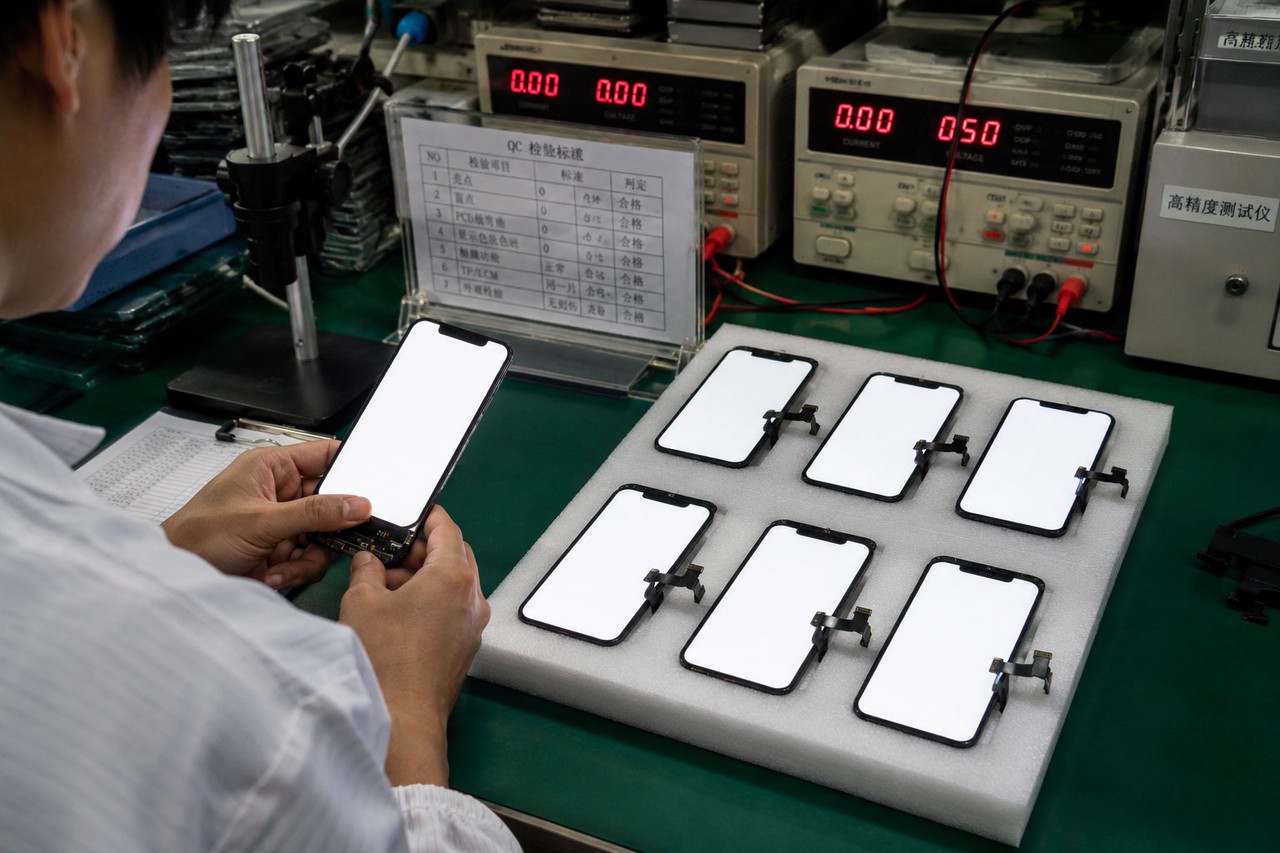
Backlight uniformity: the failure nobody talks about until it's too late
Backlight uniformity is the most underrated quality variable in LCD screens, and it's the one I spend the most time on with new accounts because it generates the most delayed returns - the ones that come back at the eight-week mark rather than the first week.
Here's the physics of it. An LCD panel doesn't generate its own light - it modulates light from a backlight assembly behind it. The backlight uses a combination of LEDs, a light guide plate, a diffuser film, and a reflective sheet to distribute light as evenly as possible across the panel surface. If any of these components are slightly misaligned during assembly - and we're talking about tolerances measured in fractions of a millimetre - the light distribution will be uneven.
At full brightness, this unevenness is often invisible because the entire panel is bright enough to mask the variation. At 30–50% brightness - which is where most people actually use their phones indoors - it becomes visible as a brighter patch near one edge, or a slightly darker corner, or a faint vertical band running down the screen.
The customer rarely connects this to the recent repair. They just notice their screen looks a bit off. They might not mention it at all, or they might mention it six weeks later when they come in for something else. Either way, it's a quality signal that damages your reputation over time even when no formal complaint is made.
Our rejection threshold for backlight uniformity variance is 15% across the panel surface, measured at 50% brightness. In practice, this means we reject roughly 3.2% of panels that pass the dead pixel check cleanly. Those panels would have been shipped by any supplier whose QC stops at dead pixels.
The colour temperature problem that makes batches look inconsistent
This one is subtle but matters more than most buyers realise, and it's entirely a supply chain management problem rather than a manufacturing defect in the traditional sense.
LCD panels are manufactured in large production runs called lots. Within a single lot from a single factory, the colour temperature - the warmth or coolness of the white point - will be highly consistent. Across different lots, even from the same factory, there can be a visible difference. This is normal in panel manufacturing and is managed in the consumer electronics industry by careful lot matching during device assembly.
In the repair parts market, nobody manages lot matching. A supplier with 500 units of iPhone 12 screens in stock might have received those units across three separate shipments, each from a different panel lot. The screens are all "Grade A," they all pass dead pixel checks, they all function correctly. But the white point varies between lots - some slightly warm, some slightly cool.
For a repair shop fitting one screen to one phone, this is usually invisible because there's no side-by-side comparison. But for a repair shop fitting multiple screens to a fleet of corporate phones, or for a customer who has their phone repaired and then holds it next to a friend's iPhone of the same model, the difference can be noticeable.
The question to ask any supplier: "Do you track panel lot numbers per shipment, and are the units in a single order from a single lot?" Most suppliers don't know the answer, which tells you they're not managing this. We do track lot numbers and we try to ship single-lot batches wherever stock allows - and we flag it proactively when we can't.
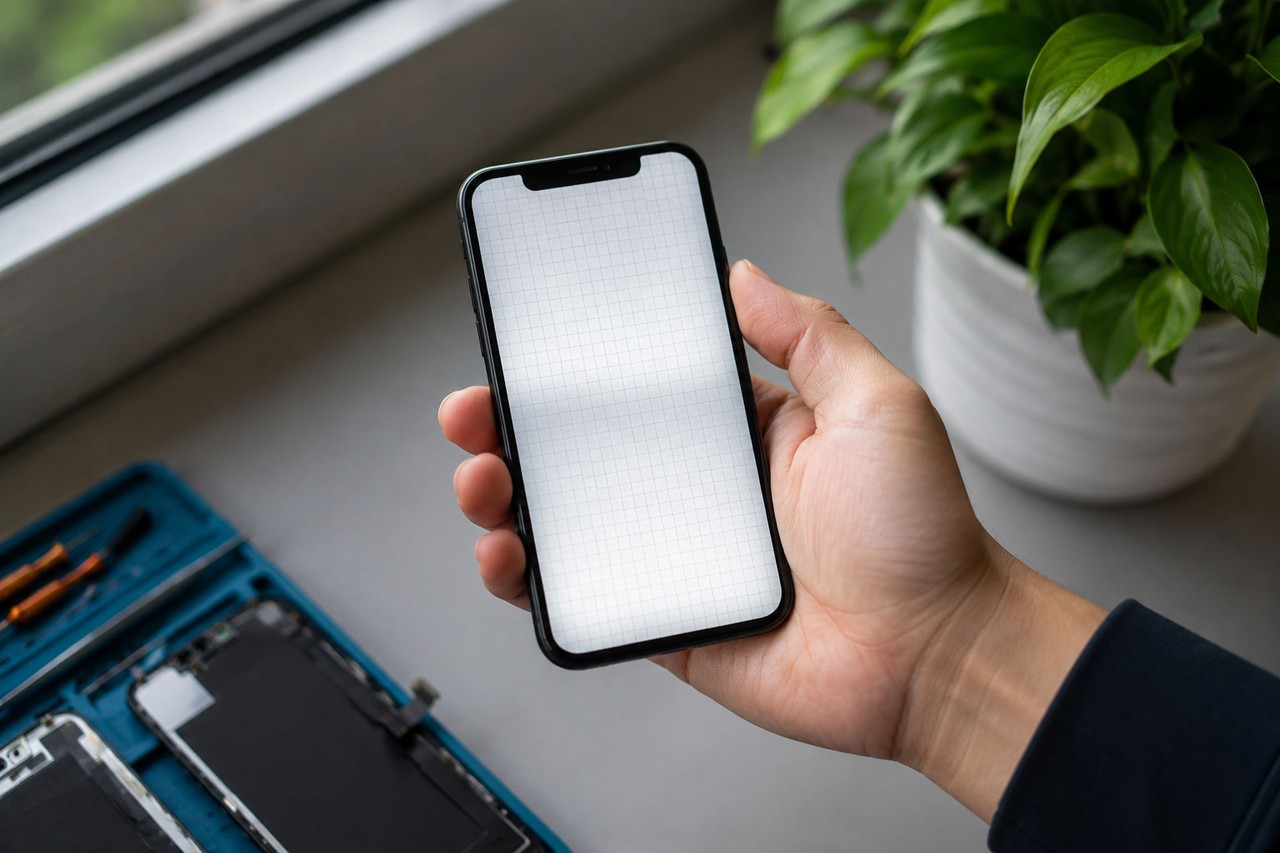
Six questions that actually separate good suppliers from average ones
I want to give you six specific questions you can put to any supplier, and explain what the answers tell you.
Question 1: "What is your backlight uniformity test threshold?"
If they can give you a specific number - a percentage variance tolerance - they're running quantitative backlight testing. If they say "we check for obvious backlight issues" or similar vague language, they're doing visual inspection only, which catches severe failures and misses moderate ones.
Question 2: "What's your five-point touch calibration offset tolerance?"
The answer should be a specific distance - ours is ±2mm. If they say "we test touch function," that's connectivity testing, not calibration testing. Those are different things and produce different outcomes.
Question 3: "Do you track panel lot numbers per shipment?"
This tells you about their inventory management and traceability. A supplier who tracks lot numbers can isolate a quality problem to a specific production run if one emerges. A supplier who doesn't track lot numbers cannot - which means if a batch problem develops, they have no way of identifying which orders were affected.
Question 4: "What was your outgoing defect rate for iPhone [specific model] in the last 90 days?"
Any supplier running measurement-based QC will have this number. The specific number matters less than whether they can answer the question at all. A supplier who doesn't measure defect rate per model doesn't have data-driven QC - they have visual inspection.
Question 5: "What is your connector flex-cycle test protocol?"
The flex cable connector is the most mechanically stressed component in a replacement screen assembly. We cycle each connector five times and test functionality after each cycle. If a supplier has never considered this as a test point, their screens may pass bench testing and fail under real-world installation.
Question 6: "How do you handle a batch quality dispute if I discover a systematic problem three weeks after receiving an order?"
This question tells you about the supplier's accountability culture more than anything else. The right answer involves a clear process: they want specific unit documentation, they'll review their lot records for that shipment, and they have a defined resolution path (credit, replacement, or investigation). A vague answer - "we'll try to help, don't worry" - tells you there's no process, which means the outcome of any dispute will depend entirely on how persistent you're willing to be.
What our QC actually catches that a dead pixel check misses?
To make this concrete, here's data from our outgoing QC for the past rolling 12 months, for iPhone 11 and iPhone 12 Incell panels specifically.
Panels that passed dead pixel check but were rejected at other QC stages:
- Rejected at backlight uniformity: 3.2% of total processed
- Rejected at five-point touch calibration: 1.4%
- Rejected at ghost touch monitoring: 0.9%
- Rejected at connector flex-cycle: 0.6%
- Rejected at final visual (handling damage, surface contamination): 1.1%
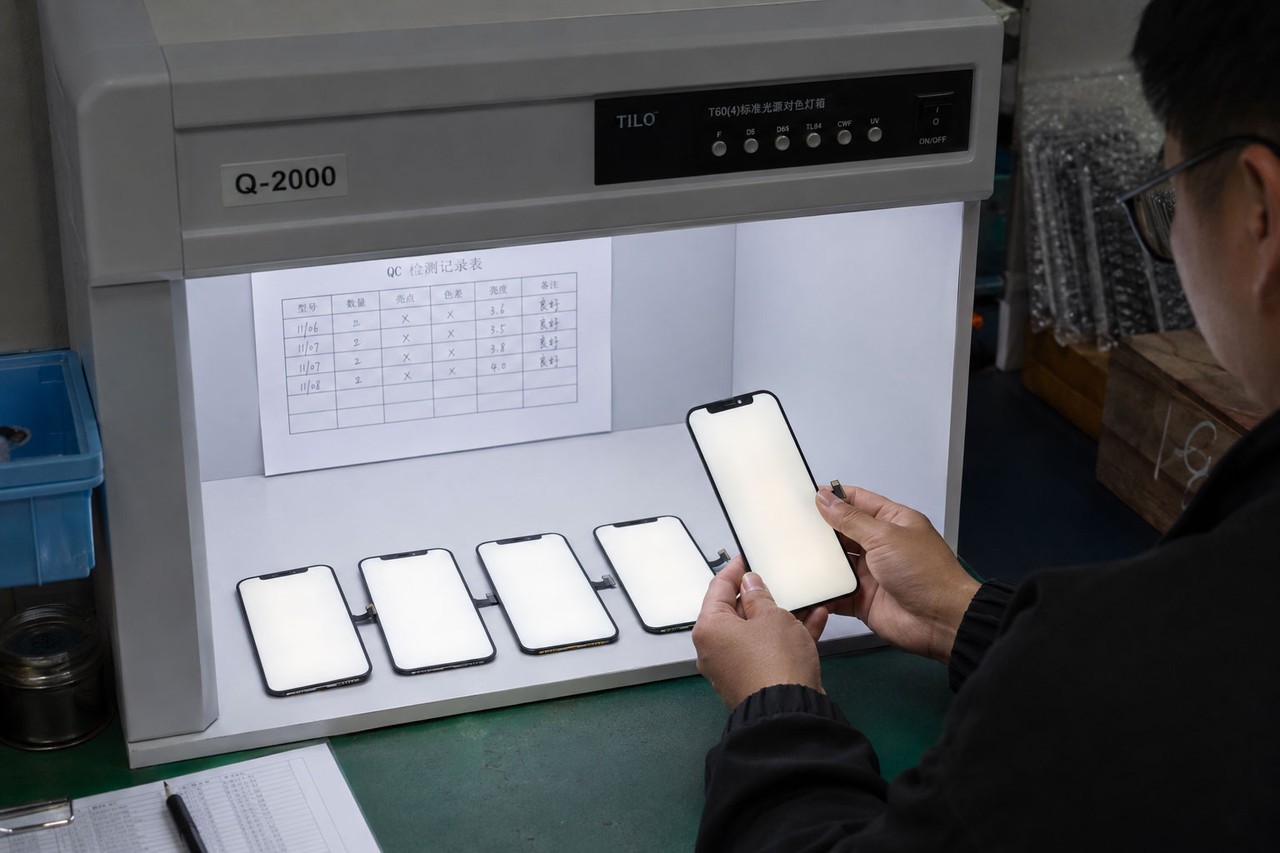
Combined, this means 7.2% of panels that would have been shipped by a dead-pixel-only QC operation were caught and rejected by our additional testing stages. On a 200-unit order, that's roughly 14 screens that would have reached your workshop - and eventually your customers - if we only checked dead pixels.
The dead pixel promise is real. It's just not enough.